Aquarium Carpet Plants Without CO2: The Truth
6 min read · 2026-10-23
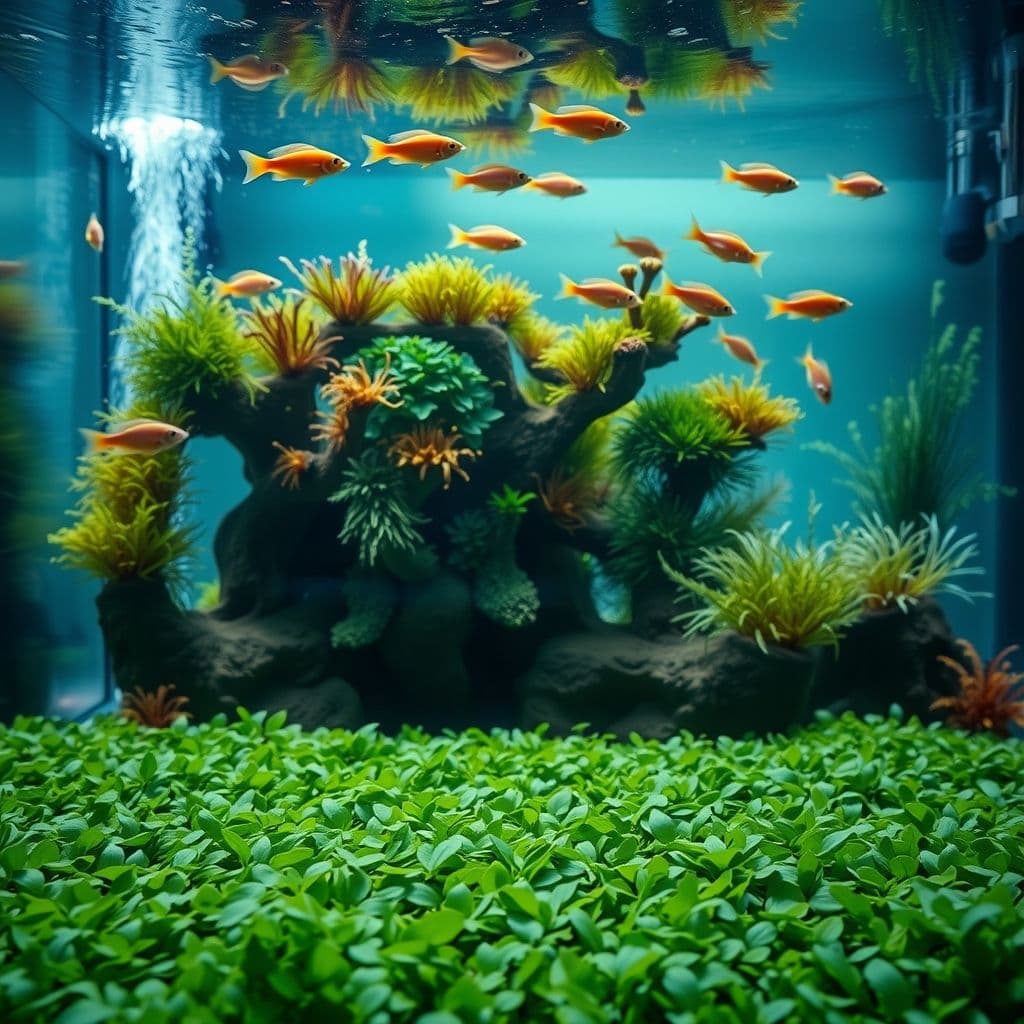
Can You Carpet a Tank Without CO2? Yes, But Be Realistic
You can grow carpet plants in a freshwater aquarium without injecting CO2. But don't expect the fast, dense, golf-course-style carpets you see in high-tech tanks. Those vibrant, thick carpets, often of plants like Glossostigma elatinoides or Hemianthus callitrichoides 'Cuba', rely heavily on a constant, rich supply of carbon dioxide.
Without CO2, growth will be significantly slower, and your plant choices are limited. It's a challenging path that demands patience, precise lighting, and diligent nutrient management. If you are prepared for a marathon, not a sprint, then a modest carpet is achievable.
Why CO2 Matters for Carpeting Plants
Before diving into the "how-to" without it, understand why CO2 is usually recommended. Carbon dioxide is a primary ingredient for photosynthesis, the process plants use to convert light energy into growth. When CO2 is abundant, plants can photosynthesize faster, grow quicker, and absorb nutrients more efficiently.
Without supplemental CO2, plants rely on the much lower levels naturally present in the water. This severely limits their growth rate. For a plant to carpet, meaning it grows horizontally and densely, it needs to grow fast enough to spread before it's outcompeted by algae or shaded by taller plants. CO2 provides that needed boost.
A full CO2 setup, like a CO2 Starter Kit including a dual-gauge regulator, inline atomiser, and glass drop checker, costs $109.95. Or, for a more budget-friendly approach, a DIY CO2 Generator Kit for $65.95 can provide some CO2, but it's less consistent than a pressurized system. If you're serious about a fast, dense carpet, these options deliver. If you're committed to avoiding CO2 entirely, understand the trade-offs.
The Best Carpet Plants for No-CO2 Tanks
Your plant selection is critical. Forget the extremely demanding species. Focus on hardier, slower-growing alternatives:
- Dwarf Sagittaria (Sagittaria subulata): This is one of the most reliable options. It propagates by runners, forming a grassy carpet. It can grow taller in lower light, but with moderate to high light, it stays compact.
- Marsilea hirsuta: Resembling a four-leaf clover, Marsilea is slow to establish but will eventually spread. It can take months to form a dense carpet, but its unique look is worth the wait for many.
- Cryptocoryne parva: This is a tiny Cryptocoryne species. It's notoriously slow-growing but will form a dense, low carpet over a very long time. Patience is key with C. parva.
- Staurogyne repens (S. Repens): While it can grow quite tall, S. Repens can be encouraged to carpet with consistent, aggressive trimming. Each trimmed stem can be replanted to help fill in gaps. It needs good light to stay low.
- Monte Carlo (Micranthemum tweediei): This plant is often marketed as a low-tech carpet option, but it's a stretch. While it can survive without CO2, it grows extremely slowly, often struggles to carpet densely, and can melt back. It requires very strong lighting and perfect nutrient balance to have any chance. For a true no-CO2 setup, it's generally not worth the frustration.
- Java Moss (Taxiphyllum barbieri): Not a true carpet plant in the traditional sense, but Java Moss can be tied or glued to mesh and laid on the substrate. With regular, heavy trimming, it can create a textured, mossy foreground. It's extremely hardy and requires no special care beyond light.
Avoid plants like Eleocharis parvula (Dwarf Hairgrass) or Hemianthus callitrichoides 'Cuba' (HC Cuba) entirely if you are not running CO2. They simply won't thrive or carpet effectively.
Lighting: A Crucial Trade-off
Without CO2, light becomes even more critical for encouraging horizontal growth. Carpet plants need moderate to high light to stay low and spread. However, this is a tricky balance. High light without enough CO2 can lead to rampant algae growth, as the plants can't utilize the light effectively.
Aim for a light that offers good intensity without being overkill. For smaller tanks, an RGBW 55 Full Spectrum LED with 15 W and 66 LEDs could work for tanks 40–55 cm wide, offering 24-hour auto on/off. For larger tanks, the Aurora 48 Planted Tank LED Bar provides 20 W with 40 LEDs, suitable for tanks 48–61 cm wide. For serious intensity on a larger setup, the Aurora Smart 78 RGB App-Controlled LED delivers 34 W and 4200 lm, fitting tanks 70–95 cm. The more powerful lights will give you a better chance at carpeting, but you must monitor for algae.
Start with a shorter photoperiod, perhaps 6-7 hours a day, and gradually increase it if algae isn't an issue and plants are growing. Consistency is key.
Substrate and Fertilization: Feeding Your Carpet
Since your plants are CO2-limited, they need every other advantage you can give them. This means a rich substrate and a consistent fertilization routine.
Substrate
For most carpet plants, particularly heavy root feeders like Dwarf Sagittaria and Cryptocoryne parva, a nutrient-rich substrate is essential. This provides a slow-release source of nutrients directly to their roots. A plain gravel substrate will not cut it for a demanding carpet. If you're using an inert substrate like sand, you will need to supplement heavily with root tabs.
Root Tabs
Regardless of your chosen substrate, Root Fertilizer Tabs are a smart investment. For $11.95, a pack of 40 capsules can be pushed directly into the substrate beneath your carpeting plants. These provide essential micronutrients and macronutrients where the roots can access them. Replenish them every few months, following product instructions.
Liquid Fertilizers
Many carpet plants, even root feeders, also absorb nutrients from the water column. An All-in-One Liquid Plant Fertilizer, priced at $27.95, provides NPK (Nitrogen, Phosphorus, Potassium) along with a full spectrum of micronutrients. Dosing this regularly, typically daily or every other day, is vital to ensure your slow-growing carpet plants don't starve. Without CO2, plants are less efficient at nutrient uptake, so a consistent supply in the water column helps.
Start with a reduced dose and watch your plants. If leaves look pale or growth stalls, you might need to increase it. If you see excessive algae, reduce it and check your lighting.
Maintenance and Patience: The Unsung Heroes
Growing a carpet without CO2 isn't a "set it and forget it" task. It demands consistent attention:
- Trimming: Regular trimming encourages denser, bushier growth. For plants like S. Repens, it's how you force them to carpet. Remove any melting or struggling leaves immediately.
- Water Changes: Consistent water changes (20-30% weekly) help replenish trace elements, remove waste, and keep parameters stable. This is good practice for any planted tank, but particularly important when plants are under stress.
- Algae Control: Algae is your biggest enemy. Without CO2, plants grow slower, making them less competitive against algae. Maintain pristine water quality, avoid overfeeding fish, and ensure your light cycle isn't too long or too intense initially. If algae appears, address it quickly.
- Spot Treatment: If you get spot algae, use a soft brush or a targeted hydrogen peroxide treatment (diluted, with extreme caution) to remove it.
- Patience: This cannot be stressed enough. A dense carpet without CO2 can take many months, or even over a year, to establish. Do not get discouraged by slow progress. Consistency in your routine will eventually pay off.
A no-CO2 carpet is a test of dedication. It's cheaper than a full CO2 system up front, but it demands more effort and a different kind of reward: the satisfaction of coaxing slow, natural growth.
Quick answers
- Can I really grow a carpet without CO2?
- Yes, but you must manage your expectations. Growth will be slower, the plant selection is limited, and a dense, 'golf-course' style carpet is extremely challenging without CO2.
- What are the easiest carpet plants for a low-tech tank?
- Dwarf Sagittaria and Marsilea hirsuta are among the more forgiving options for carpeting without injected CO2, though they still require patience and good conditions.
- Do I need special substrate or fertilizer for a non-CO2 carpet?
- Yes, a nutrient-rich substrate is vital, as are root tabs for heavy root feeders. Liquid fertilizers are also necessary to supply nutrients in the water column.
- How much light do I need for a carpet without CO2?
- Moderate to high light is typically required to encourage carpeting growth, but this increases the risk of algae without CO2 to balance it. It's a tricky balance to strike.